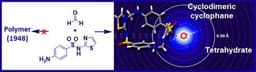
In Quest of an Efficient Positive Electrode Material for Aqueous Al‐Ion Hybrid Capacitor: Investigation of a High Entropy Prussian Blue Analog
Von Wiley-VCH zur Verfügung gestellt
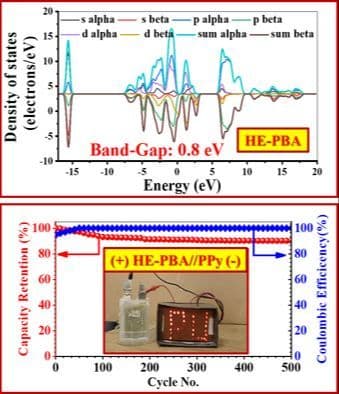
An aqueous Al-ion hybrid capacitor (AIHC) employing a high-entropy Prussian blue analog (HE-PBA) as a positive electrode material is reported. Combined characterization using energy-dispersive X-ray analysis, Fourier transform infrared spectroscopy, and thermogravimetric analysis confirms the chemical composition of HE-PBA as Na2Mn0.2Co0.2Ni0.2Cu0.2Zn0.2[Fe(CN)6]0.96.0.5H2O. The HE-PBA crystalizes in monoclinic phase (space group P2 1 /n) with a bandgap of 0.8 eV. XPS data reveals that only Ni and Fe exhibit both bivalent and trivalent states, while other transition metals remain in the bivalent state. Electrochemical analysis indicates a diffusion-controlled mechanism (b ≈ 0.6) associated with HE-PBA with a diffusion coefficient of 9.2 × 10⁻¹⁴ cm2 s−1. An AIHC device is assembled using HE-PBA positive and polypyrrole negative electrodes in a SiO2-Al2(SO4)3 hydrogel electrolyte, where the electrodes operate via Faradaic and pseudo Faradaic processes, respectively. The device exhibits an energy density of 20 Wh kg−1 (@ 78 W kg−1), a power density of 378 W kg−1 (@ 8 Wh kg−1), and outstanding cycling stability (90% capacity retention after 500 cycles at 300 mA g−1). It also shows an ultrafast response time of 0.66 s, highlighting excellent power capability. Compared to the only five reported aqueous AIHCs, this study demonstrates promising electrochemical performance despite the challenges of trivalent Al³+ insertion/deinsertion in aqueous media.