Imidazolyl Phosphine as Versatile Hemilabile Ligand: Synthesis and Characterization of a New Tetracationic Au20 Nanocluster
Von Wiley-VCH zur Verfügung gestellt
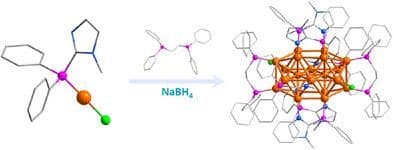
A new imidazolyl-phosphine-protected tetracationic Au20 nanocluster has been readily synthesized, which underlines the potential of imidazolyl phosphine in the syntheses of hemilabile ligand-protected Au nanoclusters, and provides a new opportunity for further enriching the library of Au NCs with dynamically labile Au─N bonds and potentially better catalytic performance.
Abstract
As the new type of molecular catalysts, hemilabile ligand-protected Au nanoclusters hold greater promise in realizing a better trade-off between catalytic activity and structural stability. Despite the large amount of Au nanoclusters (co-)protected by organic nitrogen ligands, little has been known about those containing dynamically labile Au─N bonds, where the hemilabile ligands are solely limited to pyridyl-phosphine. In this study, we chose imidazolyl-phosphine (dpim) as the main protecting ligand and synthesized a new tetracationic cluster [Au20(dpim)6(dppe)2Cl2]4+ (Au20-S, dppe = Ph2P(CH2)2PPh2), which was structurally characterized crystallographically, spectroscopically, and computationally. Albeit the similar electronic structure of the Au20 core, Au20-S possesses different ligand arrangements and positive charges from those of its two reported structural analogues, and thus they may serve as an ideal cluster triad for comparatively studying the ligand/charge effect on their catalytic activities. This work proved the potential of imidazolyl phosphine as a versatile hemilabile ligand in the syntheses of Au NCs with labile Au─N bonds. The imidazolyl-phosphines are more amenable to derivatizations, which provides a new opportunity for further enriching the library of hemilabile ligand-protected Au NCs with potentially better catalytic performance.