Graphitization Degree Regulation of Carbon‐Coated Catalysts to Improve the Freshwater/Seawater Splitting Performance
Von Wiley-VCH zur Verfügung gestellt
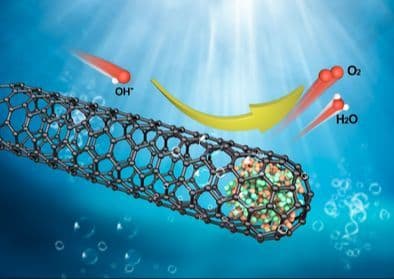
In this study, we propose a strategy to optimize the OER catalytic performance by precisely controlling the graphitization degree of the carbon-coating structure. The resulting catalyst exhibits excellent electrocatalytic activity with overpotentials as low as 270 mV in 1 M KOH and 303 mV in 1 M KOH + seawater to reach 10 mA cm−2, coupled with robust stability under operational conditions, demonstrating its superior potential for water splitting applications.
Abstract
Advancing efficient oxygen evolution reaction (OER) catalysts for both freshwater and seawater electrolysis to enable sustainable green hydrogen production is a critical yet challenging pursuit in renewable energy research. In this work, a N-doped carbon nanotube encased NiFe alloy catalyst (NiFe@NCNT) is designed and synthesized, to balance the trade-off effect of the activity and stability with optimizing the graphitization degree of the carbon shell. The NiFe@NCNT catalyst demonstrates exceptional OER performance in both freshwater and seawater electrolytes, owing to its high conductivity, abundant active sites, robust anticorrosion properties. The NiFe@NCNT exhibits the overpotentials as low as 270 mV in 1 M KOH and 303 mV in 1 M KOH + seawater to reach 10 mA cm−2, coupled with robust stability under operational conditions. Remarkably, the Pt/C||NiFe@NCNT pair demonstrates superior performance, attaining 10 mA cm−2 at 1.627 V in 1 M KOH + seawater electrolyte, outperforming the conventional Pt/C||RuO2 configuration and highlighting its immense potential for scalable green hydrogen production from seawater.