ARTIKEL

Genome Mining Reveals a Novel Nephthenol‐Producing Diterpene Synthase from the Sandfly Lutzomyia Longipalpis
25.08.2025
Genome Mining Reveals a Novel Nephthenol‐Producing Diterpene Synthase from the Sandfly Lutzomyia Longipalpis

Von Wiley-VCH zur Verfügung gestellt

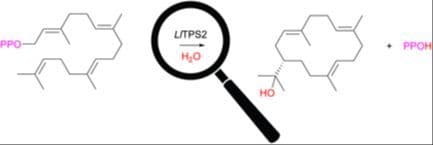
The discovery of a terpene synthase of insect origin that makes the apparently cryptic product nephthenol from geranylgeranyl diphosphate sheds light on hidden biosynthetic potential.


Populations of the sandfly, Lutzomyia longipalpis, use the diterpene sobralene as a sex/aggregation pheromone, which is likely produced in the insect through the activity of a recently discovered noncanonical terpene synthase (TPS). This study shows that the genome of this insect also contains another noncanonical TPS able to produce principally (S)-(+)-nephthenol (isoserratol) from geranylgeranyl diphosphate. This diterpene alcohol does not appear to be produced by the sandfly, nor is the corresponding TPS gene transcribed, hence these findings suggest that insects may be a promising source of TPSs for apparently cryptic terpenoid products.

Verwandte Artikel

Genome Mining Reveals a Novel Nephthenol‐Producing Diterpene Synthase from the Sandfly Lutzomyia Longipalpis
Artificial Peptides as Autophagy Modulators
Genome Mining Reveals a Novel Nephthenol‐Producing Diterpene Synthase from the Sandfly Lutzomyia Longipalpis
Homogeneous Electrochemical Enzyme‐Linked Immunosorbent Assay Strategy Based On pH‐Mediated Redox Potential Regulation
Genome Mining Reveals a Novel Nephthenol‐Producing Diterpene Synthase from the Sandfly Lutzomyia Longipalpis
Quantitative Strategies for Decoding Organelle Ion Dynamics
Genome Mining Reveals a Novel Nephthenol‐Producing Diterpene Synthase from the Sandfly Lutzomyia Longipalpis
Novel Platinum(II) Tetrazine Complex Capable of Live‐Cell IEDDA Reaction
Genome Mining Reveals a Novel Nephthenol‐Producing Diterpene Synthase from the Sandfly Lutzomyia Longipalpis
Investigating the Interaction Profile of Unconjugated Ubiquitin: Chemical Biology and Affinity Enrichment Mass Spectrometric Approaches