Dual‐Functional Antimicrobial and Anticoagulant Coatings: Synergistic Mechanisms, Research Advances, and Translational Challenges
Von Wiley-VCH zur Verfügung gestellt
This review examines emerging strategies for dual-functional coatings that simultaneously combat bacterial colonization and thrombus formation on blood-contacting medical device surfaces. Researchers now integrate antimicrobial activity with thrombus resistance through molecular design, structural biomimicry, and adaptive mechanisms. The discussion highlights critical advancements in achieving synergistic biological defense while addressing remaining challenges for clinical translation.
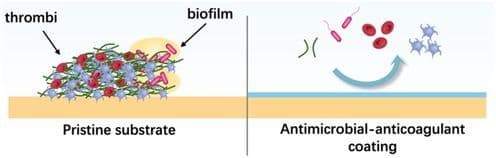
The adhesion of biological components such as bacteria, proteins, and platelets on material surfaces triggers biofilm formation and thrombus generation, which leads to severe infections and embolism risks in blood-contacting medical devices. Conventional blood-contacting coatings predominantly focus on singular antibacterial or anticoagulant functions, while clinical demands urgently require surfaces with synergistic "antibacterial-anticoagulant" efficacy to address complex biofouling challenges. Recent advancements in dual-functional antibacterial-anticoagulant coatings have achieved notable progress. This review summarizes four representative categories: (1) antimicrobial-dominant antifouling coatings, which combine active bactericidal mechanisms to inhibit biofilm formation with passive antifouling strategies to suppress thrombogenesis; (2) anticoagulant-loaded bifunctional coatings, merging sustained-release anticoagulant agents with antibacterial active components or antifouling layers to achieve dual active defense; (3) physically biomimetic bifunctional coatings, leveraging micro/nanotopological architectures and surface chemical mimicry to disrupt bacterial adhesion and platelet activation simultaneously; and (4) environment-responsive smart coatings, enabling stimuli-responsive dynamic switching of antibacterial functions to adapt to in vivo microenvironmental changes. This review discusses the design principles and operational mechanisms of coatings while highlighting persistent challenges. Future research should focus on precisely functionalizing interfaces, enhancing synergistic properties, and optimizing dynamic adaptability to promote their practical applications.