Cu(I) and Cu(II) Complexes with a Piperazine‐Containing N,N,O‐Chelate Ligand: A Combined Theoretical and Experimental Investigation
Von Wiley-VCH zur Verfügung gestellt
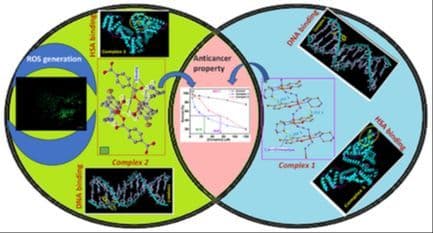
DNA, protein binding and anticancer property property along with ROS generation ability of Cu(II) and Cu(I) complexes.
The present work highlights the development of one Cu(II) complex [CuL(μ1,3-N3)]∞ (complex 1) and Cu(I) complex [Cu2L2(H2O)2Ph(COO)2] (complex 2) by using Schiff base HL, synthesized by the simple condensation reaction of 2-aminoethyl piperazine and 5-bromo salicylaldehyde, in the presence of sodium azide and terephthalic acid, respectively. The single-crystal data analysis reveals that complex 1 comprises an end-to-end azido-bridged polymeric network, whereas in complex 2, one ligand, one water molecule, and one deprotonated acid moiety coordinate to the Cu(I) center, resulting in a distorted trigonal bipyramidal geometry. Herein, two Cu(I) centers are connected by deprotonated terephthalic acid, forming a dinuclear complex. After rigorous characterization, the DNA and protein binding potentiality of both complexes is confirmed by using several biophysical studies, including ultra violate (UV), fluorescence, and circular dichroism titration, and a DNA melting study. Higher complexes–macromolecules binding constant values of complex 2 approve its higher association ability to both macromolecules. Molecular modeling studies corroborate the experimental findings. Furthermore, the 3-(4,5-dimethylthiazolyl-2)-2,5-diphenyltetrazolium bromide (MTT) assay study gives a solid stamp of the significant anticancer property of complex 1 toward two cancer cell lines, which is confirmed via an MTT assay study. Good reactive oxygen species generation ability is most probably the main reason for showing a good anticancer property of complex 1.