Covalent Organic Framework‐Based Solid‐State Electrolyte: Regulable Structure Promoting Lithium‐Ion Transfer
Von Wiley-VCH zur Verfügung gestellt
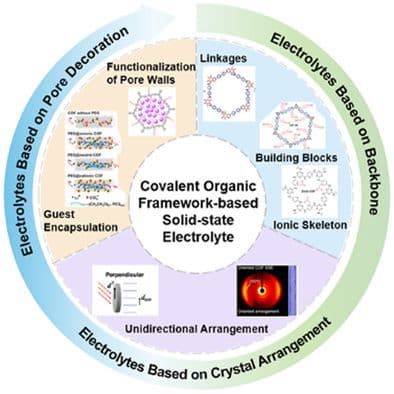
This review encapsulates the cutting-edge research progress of covalent organic framework (COF)-based electrolytes. The ingenious design of COFs, the meticulous regulation of crystalline structures, and strategic pore decorations are highlighted, which all chart new courses for innovative design strategies for advanced solid-state electrolytes.
The development of high-performance solid-state electrolytes (SSEs) is critical for advancing next-generation energy storage systems. Traditional liquid electrolytes face safety risks such as flammability, while inorganic and polymeric SSEs suffer from brittleness, low ionic conductivity, and poor thermal stability. Covalent organic frameworks (COFs), with crystalline porosity, tunable functionality, and structural robustness, have emerged as promising candidates for SSEs. This review systematically explores COF-based electrolytes through design strategies including backbone engineering, crystal arrangement optimization, and pore decoration, which aims to provide a roadmap for designing advanced COF electrolytes, emphasizing molecular-level precision and multifunctional integration to overcome existing limitations in energy storage technologies.