Correlating Self‐Discharge and Cycling Performance of Batteries to Fasten Electrolytes Development
Von Wiley-VCH zur Verfügung gestellt
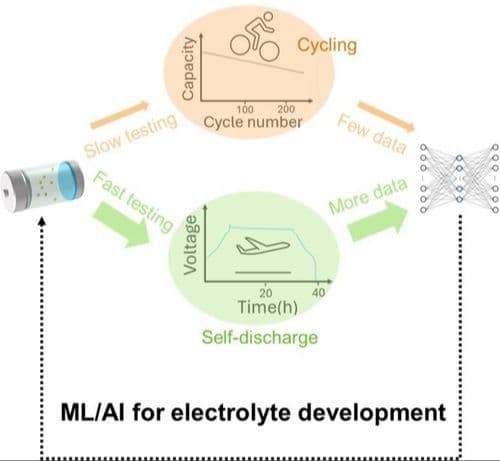
Gathering high-quality data from experimental procedures to train ML models is a laborious process, especially when the problem statements cross over to device-level applications. Here, we demonstrate that self-discharge performance and cycling performance of a battery can be correlated. As self-discharge tests can be done much faster than conventional cycling tests, and thus it can be used to accelerate materials innovation for next-generation batteries.
Abstract
The development of next-generation batteries with high energy density requires the use of novel electrode materials with high specific energy density such as lithium metal anode, silicon anode, high-Ni LiNixMnyCozO2 cathode, and sulfur cathode. The stability of these materials and their poor compatibility with conventional electrolytes limit their application, and developing novel electrolytes is one of the most promising strategies to tackle the challenge. The current electrolyte development highly relies on expert knowledge and expertise through a trial-and-error approach, which is very time-consuming. Machine learning (ML) and artificial intelligence (AI) approaches have attracted attention to accelerating the process. However, gathering high-quality data from experimental procedures to train ML models is a laborious process, especially when the problem statements cross over to device-level applications. Here, we find a strong correlation between the self-discharge behavior of lithium-metal batteries and their cycling aging performance. As the self-discharge measurement can be done within a few days compared to months for cycling tests, the finding provides a strategy to collect high-quality data in a short period that can be used as input for ML and AI approaches for developing advanced electrolytes in next-generation batteries.