Aqueous‐Phase Surface Amidation of TEMPO‐CNF Films for Improved Adsorption of Organic Pollutants in Water
Von Wiley-VCH zur Verfügung gestellt
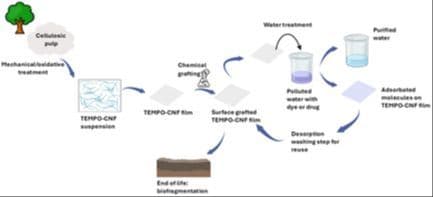
Wastewater treatment remains a critical global issue due to the release of hazardous chemicals that pose environmental and health risks. This study presents the first preparation of highly efficient and recyclable TEMPO-oxidized cellulose nanofiber (TEMPO-CNF) films, surface-grafted through a novel and straightforward method for water decontamination. The films are modified via immersion in an aqueous solution of benzylamine and DMTMM, yielding TEMPO-CNF-g-BnNH2 materials. Characterization by atomic force microscopy, attenuated total reflectance Fourier trasnsform infrared spectroscopy, X-ray photoelectron spectroscopy, elemental analysis, and water-resistance testing confirmed successful grafting. This functionalization enhanced material properties, improving water stability by 81% and reducing water uptake by 88%. Contact angle measurements, surface plasmon resonance analysis, and kinetic and thermodynamic studies indicate that the introduction of benzylamine modifies surface hydrophobicity and increases chemical affinity with organic pollutants. While π–π interactions may play a role, especially with aromatic contaminants, the sorption behavior is overall influenced by a combination of hydrophobic effects and increased molecular similarity with the target molecules. The grafted films demonstrated high adsorption capacities for methylene blue and chlorhexidine (163.9 and 217.4 mg g−1, respectively), along with excellent reusability and washability. Biodegradability tests confirmed complete degradation within 90 days. This work offers a sustainable strategy for producing advanced cellulose-based adsorbents for efficient and ecofriendly wastewater treatment.