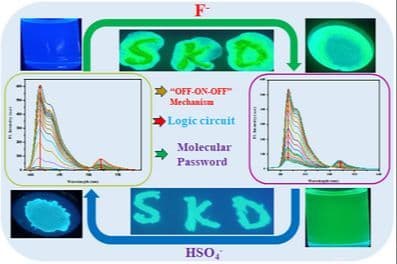
Anion‐Induced Blue to Green Color Fluorogenicity inside a Fluorescent Room Temperature Ionic Liquid and Its Implication for the Construction of Molecular Logic Gates
Von Wiley-VCH zur Verfügung gestellt
A blue-emitting room temperature ionic liquid, [TTP]+ 3[HPTS]3 −, has been introduced and utilized for cascade detection of fluoride (F−) and hydrogen bisulfate (HSO4 −) ions.
Abstract
A blue-emitting photoluminescent room temperature ionic liquids (RTILs), [TTP]+ 3[HPTS]3 − , has been synthesized and utilized as a cascade ratiometric fluoride (F−) and hydrogen bisulfate (HSO4 −) selective ionic liquids (ILs) based optical sensor. [TTP]+ 3[HPTS]3 − has been synthesized by a simple ion-exchange method comprising 8-hydroxypyrene-1,3,6-trisulfonate as anionic, [HPTS]3− and trihexyltetradecylphosphonium, [TTP]+ as cationic species, and fully characterized. The anion sensing performance of [TTP]+ 3[HPTS]3 − ([TTP]+ 3[HPTS]3 −) ILs is investigated by various spectroscopic techniques. [TTP]+ 3[HPTS]3 − shows selective chromo-fluorogenic sensing ability toward F− ions, having detection and quantification ability in the µM range displaying blue to green color fluorogenic change observable to the naked eye under a 365 nm UV lamp. A chromo-fluorogenic on-spot test kit experiment has been successfully demonstrated to recognize F− ions selectively from aqueous to nonaqueous medium. More amusingly, due to the addition of HSO4 − ions into the medium containing [TTP]+ 3[HPTS]3 −–F− ions complex, both chromo-fluorogenic color and spectral change have been reversed. These excellent findings suggest that the present ILs are an ideal candidate for the formation of molecular logic gates. The spectral change of [TTP]+ 3[HPTS]3 − for the cascade identification of F− and HSO4 − ions was observed due to the deprotonation and protonation of the anionic moiety [HPTS]3− of the present ILs. The present report evokes a new strategy for the fabrication of ILs-based sensors for the recognition and quantification of different target analytes for environmental monitoring.