Ag⁺‐Mediated Structural Reconstruction of a Metastable Cu35 Cluster Toward Cu–Ag Heterometallic Architectures for Superior Electrocatalytic CO2‐to‐Ethanol Conversion
Von Wiley-VCH zur Verfügung gestellt
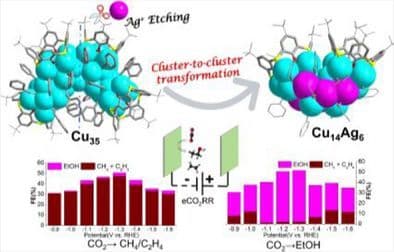
Structural remodeling of a high-nuclearity Cu35 nanocluster via Ag+ ion etching enables the construction of a bimetallic Cu14Ag6 cluster. Its Ag⋯Cu⋯Cu trimetallic sites disrupt conventional symmetric C─C coupling pathways, achieving highly selective electrocatalytic CO2-to-ethanol conversion.
Abstract
Controlled structural transformations of metal nanoclusters (NCs) via dynamic bond reorganization provide fundamental insights into cluster reactivity and open avenues for functionality tuning. Here, we report a thiacalix[4]arene-protected Cu(I)-alkynide cluster, {NaCu35(TC4A)4(Ph-C≡C)20} (Cu35 ), which exhibits remarkable structural plasticity. This metastable cluster can grow into a Cu36 species via ion substitution or undergo thermal-induced fragmentation to form a smaller Cu14 cluster. Under thermal etching by Ag+ ion, structural reconstruction is triggered, leading to the formation of the bimetallic Cu14Ag6 and Cu40Ag16 clusters. The structural reorganization significantly alters the catalytic outcomes in electrocatalytic CO2 reduction. Although the monometallic Cu35 and Cu14 favor gaseous CH4/C2H4 production, the bimetallic Cu14Ag6 demonstrates remarkable selectivity for ethanol synthesis. Notably, Cu14Ag6 achieves an impressive Faradaic efficiency (FE) of 49.27% for ethanol production, alongside a high partial current density of −67.94 mA cm−2. This marks the highest ethanol selectivity reported to date for atomically precise cluster catalysts. Mechanistic investigations reveal that, compared to homometallic Cu⋯Cu dual sites (which typically favor C2H4), the unique Ag⋯Cu⋯Cu trimetallic microstructure in Cu14Ag6 is more thermodynamically favorable for asymmetric C─C coupling between *CHO and *OCH2, facilitating the formation of the key *CHO−*OCH2 intermediate, which drives the ethanol-selective pathway.