A Review on Metal–Organic Frameworks as Catalytic Material for Oxidation Reactions
Von Wiley-VCH zur Verfügung gestellt
Metal–organic frameworks (MOFs) serve as effective heterogeneous catalysts in organic oxidation reactions, including those of alkenes, alkanes, and alcohols. Their high surface area, structural tunability, and reusability make them promising alternatives to traditional catalysts.
Abstract
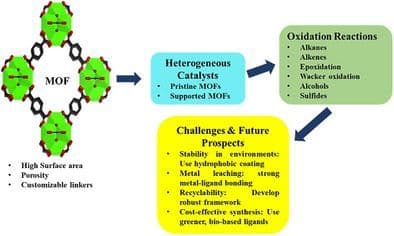
Metal–organic frameworks (MOFs) are porous materials known for their exceptional properties, such as a high surface area, porosity, customizable organic linkers, and metal nodes. These characteristics make them ideal candidates for various applications, including gas storages, catalysis, CO2 capture, drug delivery, and so on. This review focuses on the use of MOFs as heterogeneous catalysts in oxidation reaction, a vital reaction in organic chemistry for industries like pharmaceuticals and petrochemicals. We discuss both pristine and supported MOFs used in oxidation reactions, including the oxidation of alkanes, alkenes, epoxidation, Wacker oxidation, alcohols, and sulfides. The emphasis is on the active sites incorporate within MOFs and the reaction mechanism they follow. Furthermore, attention is given to modifying or enhancing these active sites to advance MOFs structure for future research in diverse application. Selective oxidation processes, such as Baeyer–Villiger oxidation are still challenging and sulfoxidation of organic compounds, enhance the value of chemical intermediates through effective catalytic reactions. This research is crucial for addressing greenhouse gas reduction and improving human health, although studies on these reactions remain limited. Despite limited reports on MOFs as oxidation catalysts, this area shows promising potential.