A Dual‐Tuning Strategy for Both Enhancing Nitric Oxide Adsorption Capacity and Reducing Desorption Residue by Functionalized Porous Resin through Constructing Hydrogen Bonds
Von Wiley-VCH zur Verfügung gestellt
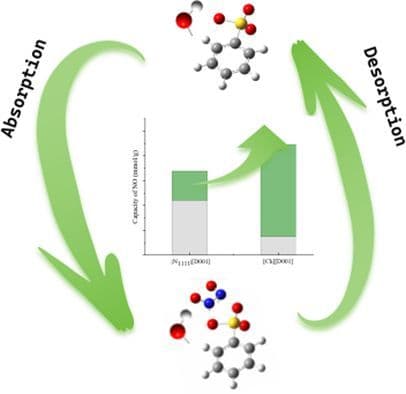
A dual-tuning strategy for both, enhancing NO adsorption capacity and reducing desorption residue of functionalized porous resins by introducing hydroxyl groups on the cation, is reported, leading to highly efficient and reversible adsorption.
In this work, a series of anion functionalized macroporous resins are successfully prepared and applied to the adsorption of anthropogenic nitric oxide (NO), where a dual-tuning strategy that improves the denitrification and regeneration performance of functionalized resins through constructing hydrogen bonds between the cation and –NONO is proposed. Based on this strategy, the adsorption capacity of NO by functionalized resins increases from 1.30 to 4.47 mmol g−1, and the ratio of desorption residue to adsorption capacity decreases from 87% to 17%. Through a combination of adsorption experiment, density functional theory (DFT) calculation, and spectroscopic investigation, it is found that hydrogen bonds between the cation and –NONO could stabilize –NONO efficiently and weaken the interaction between sulfonate anion and –NONO, resulting in the higher adsorption capacity and lower ratio of desorption residue. Finally, this novel strategy is also suitable for the design of ionic liquids (ILs), where the designed IL choline tetrazole ([Ch][Tetz]) exhibits higher capacity and better desorption than butyl triethyl ammonium tetrazole ([N2224][Tetz]) without a hydrogen bond between the cation and –NONO. It is believed that this dual-tuning method will provide a new vision for the development of denitrification functionalized materials.