3‐Dicyanomethylene‐Substituted Thienothiophenes as the Terminal Units in Non‐Fullerene Electron Acceptor Molecules for Organic Photovoltaics
Von Wiley-VCH zur Verfügung gestellt
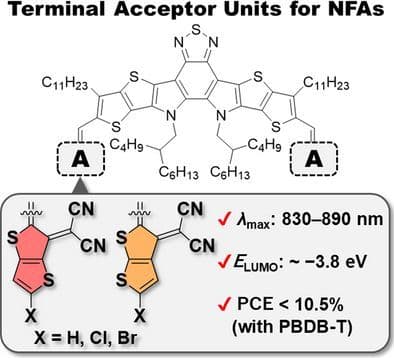
3-Dicyanomethylene thienothiophenes (CNTTs), a new series of electron acceptor units, were developed and incorporated into non-fullerene acceptors (NFAs). The CNTT-based NFAs exhibited favorable electronic structures and packing structures and thus enabled organic photovoltaic devices to achieve a power conversion efficiency of 10% when blended with PBDB-T.
Abstract
A series of dicyanomethylene-substituted thieno[3,2-b]- and thieno[2,3-b]-thiophenes and their α-halogenated derivatives (CNTTs) were developed as electron-withdrawing terminal units of non-fullerene acceptors (NFAs) for bulk heterojunction organic photovoltaics (OPVs). The series of CNTTs was combined with a [1,2,5]thiadiazolo[3,4-e]thieno[2'',3'':4',5']thieno[2',3':4,5]pyrrolo[3,2-g]thieno[2',3':4,5]thieno[3,2-b]indole (BTP) unit, the electron-donating core of Y6, a representative NFA, to afford a series of NFAs (BTP-CNTTs). The BTP-CNTTs, particularly the ones with α-chlorinated or brominated CNTT units, exhibit longer absorption wavelengths than that of Y6 and have low-lying LUMO energy levels comparable to that of Y6. Bulk heterojunction OPV devices based on the BTP-CNTTs blended with a representative donor polymer, PBDB-T, exhibited power conversion efficiencies of over 10% under AM1.5 irradiation. These results suggest that the CNTTs are good candidates as electron acceptor building units for NFAs or n-type organic semiconductors.